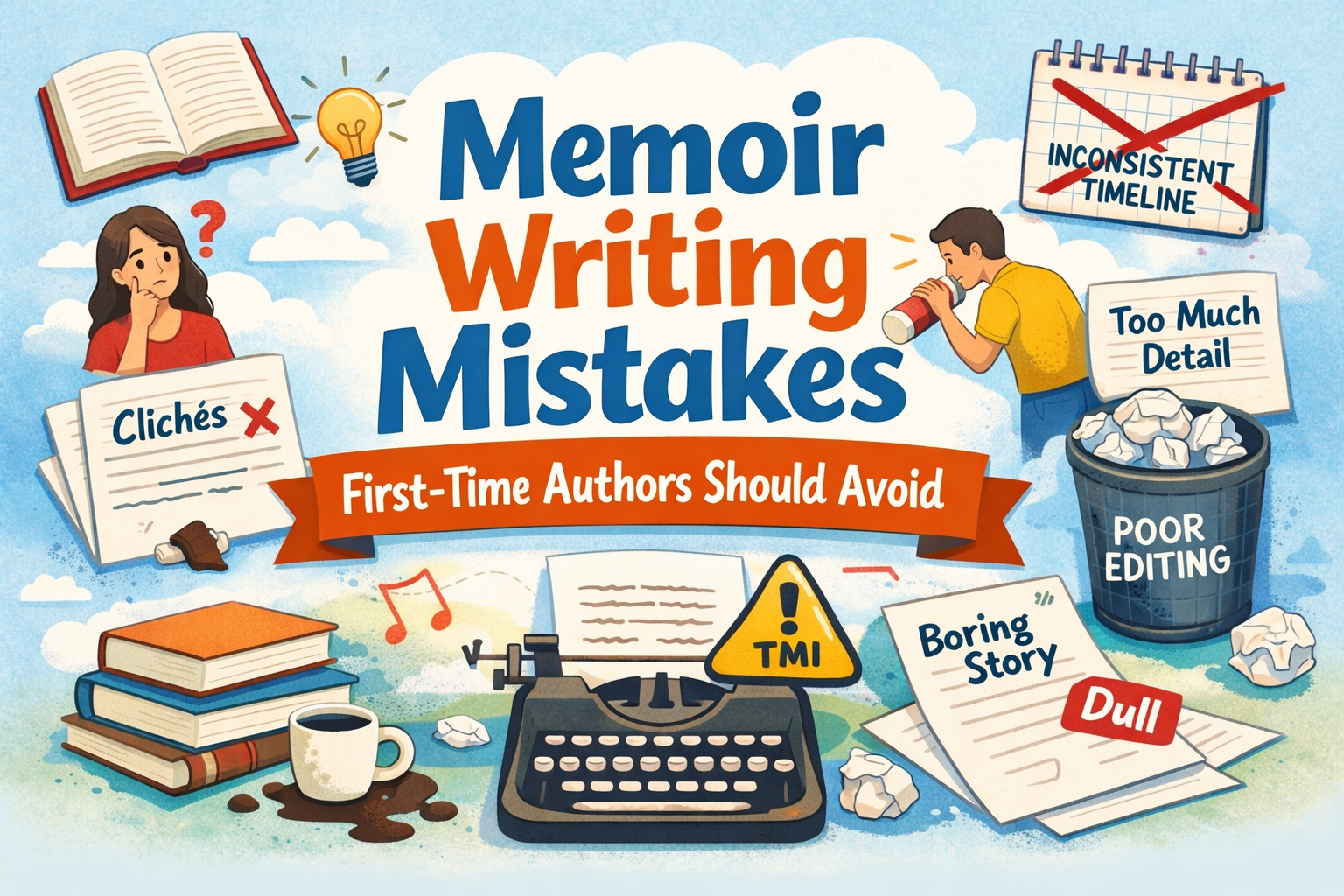
Nobody warns you that the hardest part of writing your memoir is not the writing itself. It is figuring out where to even begin. You sit down, open a blank document, and suddenly thirty years of memories are competing for the first sentence. People who go looking for memoir writing tips for beginners usually want a checklist, some rules to follow, a neat process. What they actually need is someone to tell them the truth about what tends to go wrong, and why so many first drafts end up abandoned or published in a form the author later regrets. That is what this is.
We have worked on a lot of memoirs at Indus Valley Publishers. Across all of them, certain problems come up again and again. Not because writers are careless but because memoir is genuinely hard in ways that are not obvious until you are already deep in the middle of one.
The Urge to Include Everything
Here is something that happens with almost every first-time memoir writer. They sit down intending to write about one difficult period or one relationship and within a few weeks the document has ballooned into a full life story starting from childhood. Every memory feels connected to the next. Cutting anything feels like lying.
The trouble is that a memoir covering fifty years of a person’s life rarely goes deep enough anywhere to make the reader feel something. The books that stay with people are the ones that stay in one place long enough for it to matter. Pick the story you actually need to tell. The one that has been sitting in you for years. Write that. Leave the rest for another time, or leave it out entirely.
A memoir is not your life on paper. It is the part of your life that finally needed to be said out loud.
MISTAKE 01 Treating memoir like autobiography
Opening your memoir with your birth, your parents’ history, or your childhood neighborhood before there is any reason for the reader to care is one of the most common first-draft mistakes. Drop the reader into a moment that already has weight. The backstory will find its place once the reader is already invested in you.
Writing as If the Reader Was Also There
When you mention the house on Tariq Road or your cousin Farhan who died too young, those names carry enormous weight for you. You can feel the rooms, hear the voices. The person reading your memoir has none of that. They are coming in cold and they need you to build the world for them, one specific detail at a time.
This is one of the most practical memoir writing tips for beginners and it sounds simple but it changes everything: write for the reader who was not there. Do not assume shared context. Do not skip the details that feel obvious to you. The exact way a person laughed, the smell of a particular kitchen, the tension in a car ride that nobody talked about. Those are the things that make your story feel like it actually happened.
MISTAKE 02 Assuming context the reader does not have
A first draft written for family reads very differently from one written for strangers. Your family knows who everyone is and why things mattered. Your reader does not. Every person, every place, every unspoken tension in your memoir needs at least one grounding detail that makes it real for someone encountering it for the first time.
Staying Too Clean
This is the one that is hardest to bring up with writers because it is personal. Most first drafts are written by a narrator who is, somehow, the most reasonable person in every room. They tried to make it work. They did not start the argument. The situation was not really their fault. It reads as understandable because it is. Of course you want to look okay in your own book.
But here is what readers actually respond to. Not a perfect narrator. Not someone who had it all figured out. Someone who made choices they are not proud of, who stayed too long or left too soon, who was petty or scared or wrong about something important. That kind of honesty makes a narrator trustworthy. The memoirs people return to are written by people who were willing to not look good on a few pages.
Nobody finishes a memoir thinking about how composed the narrator was. They finish it thinking about how honest they were.
MISTAKE 03 Being the reasonable one in every scene
If your memoir has no moment where you were difficult, wrong, afraid, or unfair, the reader will feel it even if they cannot name it. You do not have to confess everything. But you do have to show up as a real person, and real people are complicated. Give the reader something that costs you a little. It is worth it.
Reporting Instead of Reliving
There is a sentence that shows up in almost every early memoir draft. It sounds like this: “Those were the hardest three months of my life.” The writer knows exactly what those months felt like. But the reader gets nothing from that sentence. They receive a fact. They do not experience anything.
What works instead is the scene. Not a summary of a difficult period but the actual Tuesday afternoon inside it, what you were doing, what you were trying not to think about, what happened that you did not expect. Among all the memoir writing tips for beginners out there, the shift from reporting to reliving is the one that changes a draft the fastest. Once you see the difference you cannot unsee it.
MISTAKE 04 Summarizing instead of inhabiting
Summary has a job in memoir. It moves time forward and handles transitions. But it cannot do the emotional work that only a fully inhabited scene can do. If a moment mattered, write the scene. Give it time, place, specific sensory detail, and whatever was going on inside you while it was happening. That is where the reader actually lives.
Leaving Your Own Head Out of It
A memoir that is all external events, things that happened, people who came and went, places visited, decisions made, is exhausting to read. It is also not really a memoir. What the form asks for is the inside of an experience. What were you thinking when that happened? What were you pretending not to know? What did you understand about it only later?
Writers sometimes skip this because it feels like oversharing. Like putting too much of yourself in the room. But that interior access is exactly what a reader buys when they pick up a memoir. They want to be inside someone else’s head for a while. If you keep them locked out, they stop reading.
On Memory And Accuracy
You will not have word-for-word recall of conversations from years ago. No one does and no publisher expects it. What memoir asks for is emotional accuracy, the spirit of what was said, the feeling in the room, the thing that stuck with you afterward. You can reconstruct. You can compress. What crosses the line is inventing things that change the meaning of what actually happened. Readers can usually sense that difference even when they cannot explain it.
Writing the Safe Version
Most writers, if they are honest, know which version of their story they are telling. There is the one that will not upset anyone, the one where the difficult people are softened, the one where your own worst moments stay off the page. It feels safer. It also tends to feel a little flat, even to the person writing it.
The version that is harder to write is usually the one worth reading. Not because pain is interesting in itself but because the story that cost you something to tell carries a different weight than the one you managed carefully from a safe distance. Readers feel that weight and it is what makes a memoir stay with someone after they put it down.
MISTAKE 05 Pulling punches to protect the peace
You are not required to expose every private detail or write something cruel about the people in your life. But you are allowed to tell your story honestly, including the parts where someone let you down or where you let yourself down. Softening everything until nobody could possibly object usually means the memoir has lost the thing that made it worth writing in the first place.
Piling Up Scenes With No Real Shape
Six months in, some memoir writers find themselves sitting in front of sixty or eighty pages that feel like separate short stories. Each scene might be good. But they do not add up to anything. There is no through line. No sense of where the narrator started, what changed, and where they ended up.
This happens when writers follow memory rather than story logic. Memoir needs a shape. Not a rigid outline but some kind of arc, something the narrator is moving toward or away from, a question the book is trying to answer. You do not need to know that shape before you start writing but at some point you have to stop and ask yourself what this book is actually about. That question will reorganize everything.
MISTAKE 06 Writing scenes instead of a story
Good scenes are not enough on their own. A memoir needs to go somewhere. The reader needs to feel that something changed, something was understood, something was lost or found or finally faced. If your draft is a collection of vivid moments with no connective tissue between them, that is a structural problem, and it is better to find out in draft two than after you have published.
Thinking Your Own Eyes Are Enough
Memoir is the one genre where writers most commonly try to skip editing. The logic makes a certain kind of sense. You lived this. You know what happened. You know what you meant. Who is an editor to tell you otherwise?
The problem is that the very thing that makes memoir meaningful, your closeness to it, is also what makes it almost impossible to edit yourself. You cannot see the gaps because you already know what should be in them. You cannot tell when a scene is not doing its job because in your memory it carries weight that did not make it onto the page. A developmental editor working on memoir is not there to argue with your experience. They are there to tell you where the reader got lost, where they stopped feeling something, where the structure quietly fell apart. That is not a threat to your story. It is the thing that gives it a real chance.
What Indus Valley Publishers Offers Memoir Writers
We work with memoir writers from the earliest stages, when you are still trying to find the shape of the thing, through to final line editing before publication. Our editors know this genre and they know how to give feedback on personal material in a way that respects what you are trying to do. If you are sitting with a draft and wondering whether it is ready for outside eyes, it almost certainly is.
Waiting for the Draft to Feel Ready
The draft is never going to feel ready. That is not a flaw in you. It is just how memoir works. The material is too personal, too loaded, too much a part of you for it to ever feel finished from the inside. Writers who wait until it feels right tend to wait for years.
Showing a rough draft to a good editor or a trusted reader is not admitting defeat. It is how the book gets better faster. You might find out in chapter four that the opening is wrong, and that is a hundred times better than finding out after you have finished the whole thing. The feedback will be uncomfortable sometimes. That is what makes it useful.
Writing memoir asks you to look clearly at your own life. That takes time. But it should not take forever.